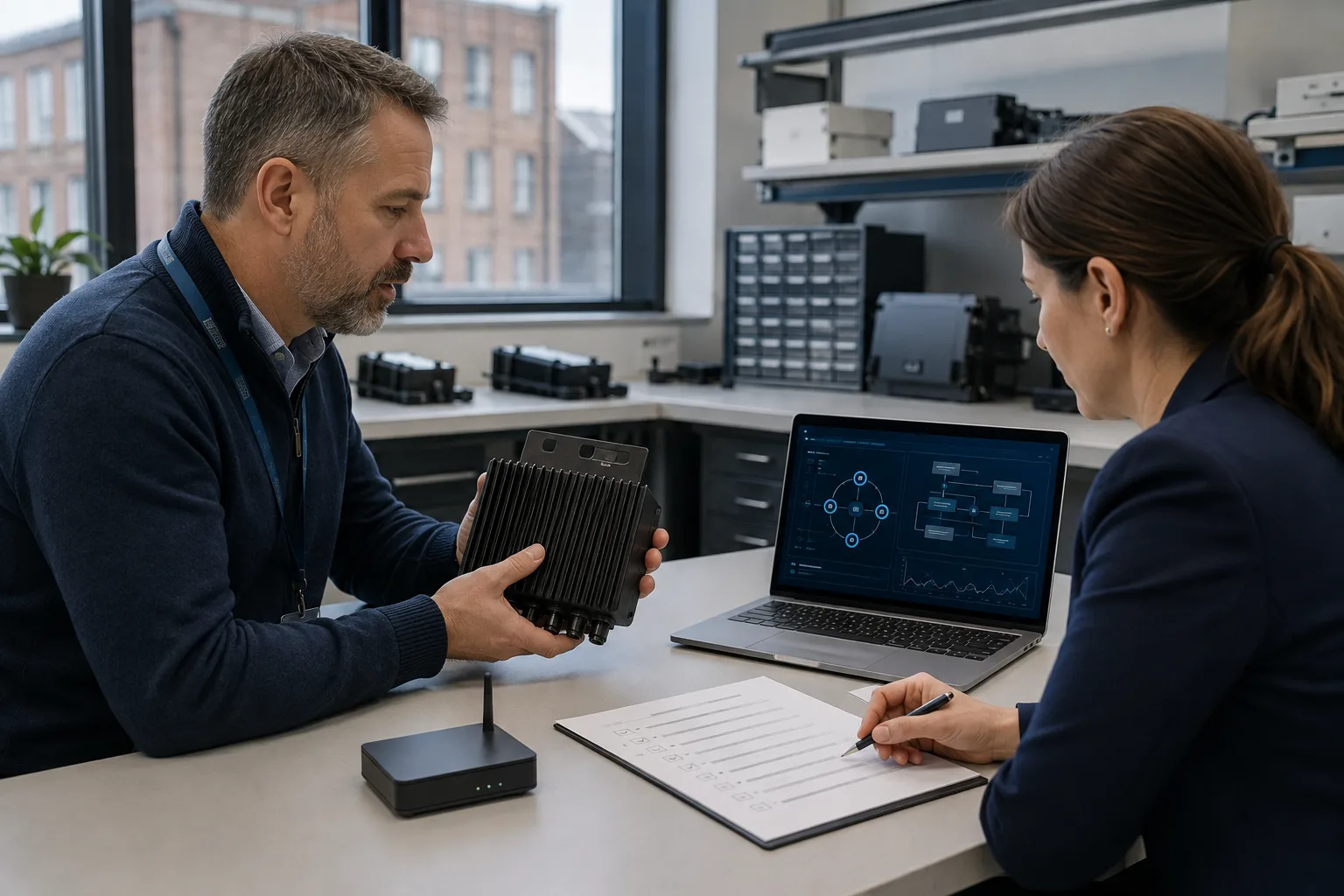
India BIS Solar Microinverter Procurement: A QCO 2025 Supplier Checklist
A buyer-side process for checking BIS registration scope, IS 16221 safety evidence, IS 16169 anti-islanding tests, model traceability and India-ready documentation before ordering.

TMG Technical Team
Compliance & Applications Engineering
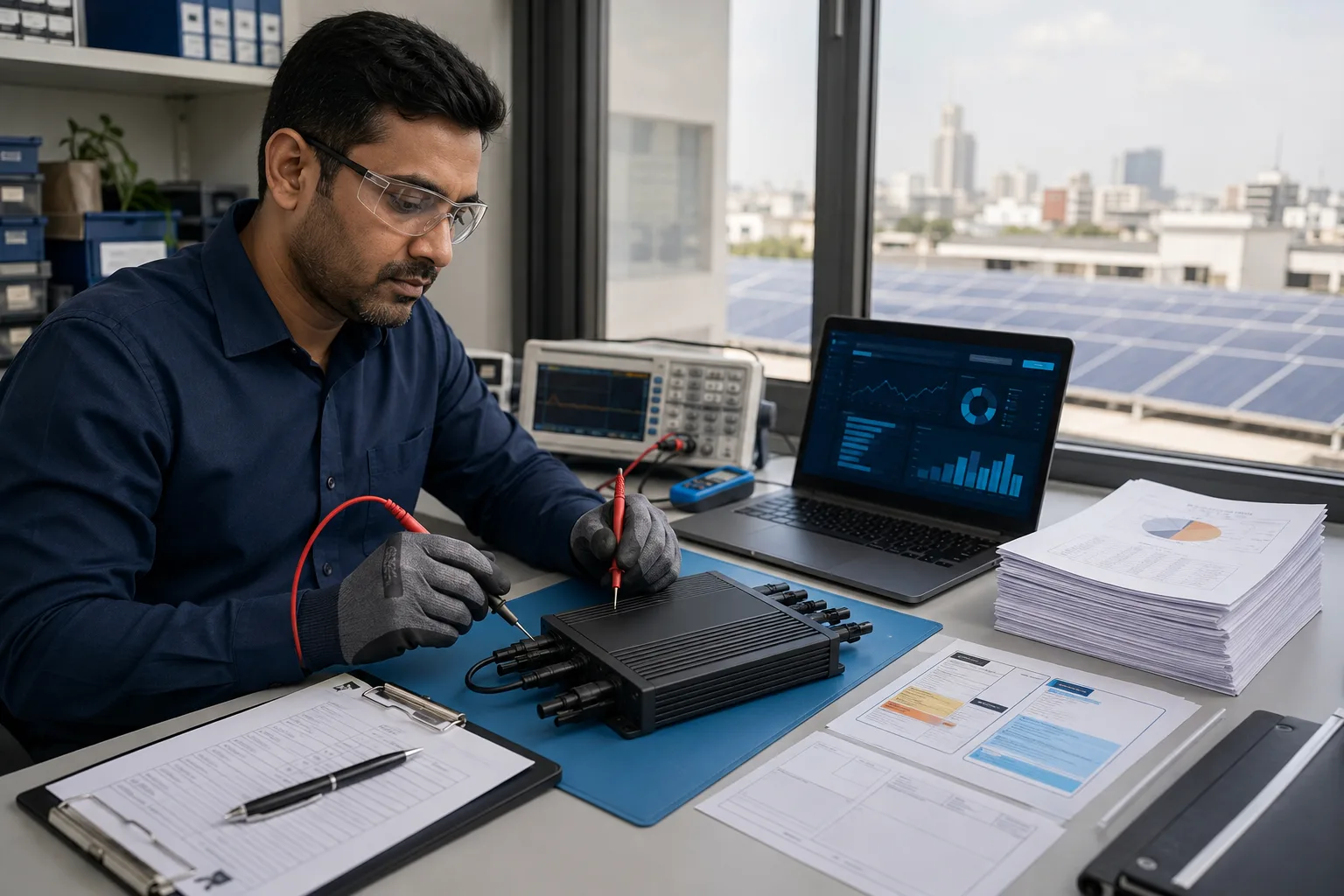
A solar microinverter offered for India should not be approved from a generic “BIS compliant” statement. An importer or distributor needs a traceable chain from the Solar Systems, Devices and Components Goods Order, 2025 to the exact brand, model, manufacturing site, test evidence and production unit being purchased.
India published the 2025 Quality Control Order (QCO) in the Gazette on 27 January 2025. The official announcement says it supersedes the 2017 order, covers inverters for solar photovoltaic applications and was scheduled to take effect 180 days after publication. Amendments, implementation dates and product classifications can change, so confirm the current MNRE notification and BIS scope when the RFQ is issued.
This checklist is a commercial due-diligence framework, not a declaration that a particular product may be imported, sold or connected. The manufacturer, Indian authorized representative or importer, laboratory, BIS, installer and local distribution company retain different responsibilities.
Freeze the product identity before reviewing certificates
Start with the exact sales configuration. Record:
- Manufacturer, trademark owner and Indian applicant or representative
- Complete model name, suffix and input-channel configuration
- AC rating, nominal voltage, frequency and phase
- Hardware revision, firmware and India grid profile
- Manufacturing-site name and address
- Gateway, branch cable and control accessories supplied with it
- Rating-label and carton artwork
A similar enclosure or higher-rated family member does not automatically cover the ordered SKU. If the product is private-labelled, do not assume the original manufacturer's paperwork automatically extends to the distributor's brand. Ask the responsible BIS party to confirm the permitted brand, model and factory scope in writing and verify it against the current registration record.
Map each Indian standard to a specific evidence question
The BIS compulsory-registration page lists solar PV inverters under Scheme II and references IS 16221 (Part 2) for power-converter safety and IS 16169 for utility-interconnected PV inverter islanding-prevention measures. Check the standard edition and amendments named in the current QCO/BIS record; do not rely on an old datasheet footnote.
| Evidence area | Procurement question | What to retain |
|---|---|---|
| IS 16221 (Part 2) safety | Does the exact construction satisfy the applicable inverter safety requirements? | Complete model-linked report, critical-component list and deviations |
| IS 16169 anti-islanding | Was the applicable phase/configuration tested for loss-of-grid behavior? | Full report, test setup, firmware/profile and model scope |
| BIS registration | Does the active record identify the ordered brand, model and factory as required? | Registration details, verified status, scope and marking artwork |
| Production identity | Does the shipment match the evaluated construction? | BOM revision, serial/batch record, label and incoming-inspection result |
Anti-islanding evidence answers one grid-protection question; it is not the entire safety or market-access file. Use the anti-islanding evidence guide when comparing the tested model, settings and local interconnection path.
Verify the BIS registration instead of collecting a screenshot
Ask for the registration details in a form that the Indian buyer can verify through official BIS records. The review should connect the registered product description to the quotation, product label, factory and invoice. Confirm that the registration is active at the agreed shipment gate and that the mandatory marking is applied exactly as authorized.
Build a controlled review sheet with:
- Registration number and current status
- Licensee/applicant and manufacturing-site identity
- Trademark and model list relevant to the purchase order
- Referenced Indian Standard and edition
- Marking format and location on product and packaging
- Renewal or surveillance dates that could affect delivery
- Written disposition for any naming, suffix or factory mismatch
Do not accept an editable certificate, cropped portal image or QR code as the only evidence. Save the verification date and reviewer because status can change between sample approval and mass shipment.
Check whether the laboratory scope matches the microinverter
The BIS laboratory information system publishes recognized-laboratory scopes for IS 16221 and IS 16169. Recognition alone is not enough: the laboratory must have the relevant standard, phase, capacity and test facilities within its current scope, and the report must identify the actual sample.
Review the report for:
- Exact model, serial number, ratings and sample photographs
- Test dates, standard edition and laboratory authorization
- Single- or three-phase configuration and applicable power range
- Hardware, grid profile and firmware used during anti-islanding tests
- Accessories essential to safety or grid disconnection
- Failed, repeated, waived or subcontracted tests and their disposition
- Signatures, issue history and any later report amendments
For sample qualification, use the OEM microinverter evaluation plan to add identity, thermal, monitoring and connector checks without pretending that incoming tests replace accredited compliance testing.
Keep five approval routes separate
Several Indian requirements can appear in the same tender, but they are not substitutes.
| Route | What it addresses | What it does not prove |
|---|---|---|
| QCO and BIS Scheme II | Product conformity and market-access evidence within the notified scope | Site-specific permission to connect |
| IS 16169 report | Islanding-prevention test evidence | Every grid setting or project approval |
| DISCOM/interconnection process | Connection of the actual installation | Factory conformity of every shipped unit |
| BEE Standards & Labeling | Efficiency labeling program for eligible grid-connected inverters | Replacement for BIS registration |
| Module ALMM/DCR documents | Module or project-procurement conditions where applicable | Inverter certification |
The BEE program announced for grid-connected solar inverters without storage up to 100 kW ran on a voluntary basis from 15 March 2024 through 31 December 2025 and required eligible products to be BIS-certified. Treat its efficiency label as a separate program and recheck any later phase before using a label claim in 2026 procurement.
Ask the Indian installer or project owner which DISCOM, tender, subsidy or project specifications apply. A national product registration should never be presented as automatic connection approval for every site.
Assemble an India-ready distributor document pack
Agree ownership and revision control before the purchase order. The pack should contain:
- Controlled datasheet and installation/user manuals
- BIS registration verification and authorized marking artwork
- Model-linked IS 16221 (Part 2) and IS 16169 evidence
- Rating-label, carton and serial-number format
- India grid-profile selection and commissioning instructions
- Approved modules, connectors, branch cables and gateway information
- Warranty terms, RMA route and Indian service contact
- Firmware release, recovery and installed-base update process
- Packing list fields that preserve model and batch traceability
EMC may also be requested by the buyer, tender or another applicable rule. Keep it as a defined technical file rather than hiding it behind the BIS safety claim; the EMC importer checklist shows how to connect reports, ports, cables and configurations.
Control OEM branding, firmware and production changes
Registration and reports have limited value if mass production drifts away from the evaluated sample. Put prior written notification into the supplier agreement for changes to:
- Brand, model, suffix or rating values
- Manufacturing site or production line
- Power stage, relay, isolation, sensing or protection circuits
- Safety-critical components and approved alternates
- Enclosure, connectors, branch cable or gateway
- Grid-control firmware, default profile or remote-update method
- Label, manual or mandatory marking
For every proposed change, decide whether document revision, engineering comparison, supplementary testing or a registration update is required before shipment. The firmware change-control guide provides a practical record for release scope, rollback and installed-base communication.
At receiving inspection, sample the model/suffix, BIS marking, serial/batch format, ratings, accessories, firmware and packaging against the approved golden file. Quarantine unexplained differences rather than allowing sales urgency to become an undocumented concession.
Add five hold points to the India RFQ
- Applicability gate: current QCO, product category, standards and responsible BIS party confirmed
- Evidence gate: registration status, exact-model reports, laboratory scope and marking reviewed
- Sample gate: hardware, firmware, label, manuals, monitoring and accessories matched
- Production gate: controlled BOM and change-notification agreement accepted
- Shipment gate: registration reverified and batch-level receiving file issued
Use a purchase-order clause such as:
Supply for India is conditional on confirmation of the current QCO/BIS applicability, active registration scope for the ordered brand, model and manufacturing site, model-linked safety and anti-islanding evidence, approved marking, controlled hardware/firmware and written review of changes before shipment.
Next step for an India microinverter RFQ
Send the intended Indian state and DISCOM, project type, brand arrangement, exact model, AC rating/phase, module datasheet, expected annual volume and requested delivery date through TMG Contact. TMG can organize the product identity and evidence matrix for technical review; final regulatory classification, registration, import and interconnection decisions remain with the responsible Indian authorities and project parties.
For a distributor-owned brand, review the OEM microinverter manufacturer solution before freezing the trademark, model naming, label, manuals, warranty chain and change-control terms.
Sources & further reading
- https://mnre.gov.in/en/notice/notification-for-solar-systems-devices-and-components-goods-order-2025/
- https://www.pib.gov.in/Pressreleaseshare.aspx?PRID=2097219&lang=2®=3
- https://www.bis.gov.in/product-certification/products-under-compulsory-certification/scheme-ii-registration-scheme/?lang=en
- https://lims.bis.gov.in/home/search_is_number/?is_number__doc_no=16221
- https://lims.bis.gov.in/home/search_is_number/?is_number__doc_no=16169&lab__lab_name__icontains=
- https://www.pib.gov.in/Pressreleaseshare.aspx?PRID=2015009&lang=2®=48
Last reviewed January 1, 2026.