Microinverter Firmware Updates: Change Control for Distributor Fleets
A lifecycle procedure for authorizing releases, staging updates, preserving grid profiles, handling rollback and supporting installed connected microinverters.

TMG Technical Team
Product Security
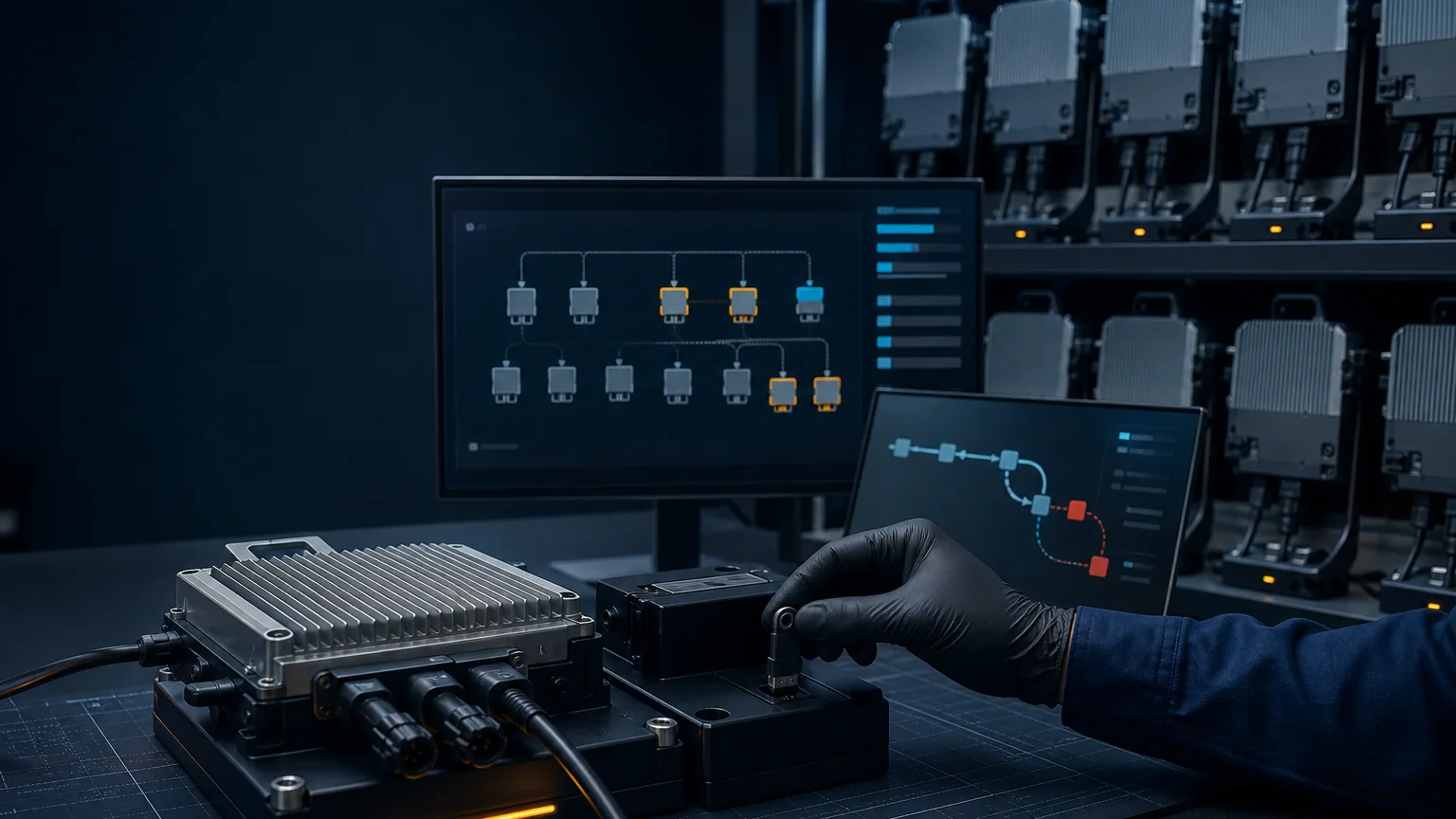
Firmware can change monitoring, grid response, power control and cybersecurity after a microinverter leaves the factory. A distributor therefore needs release governance, not only an update button.
NIST's IoT cybersecurity guidance treats secure, authorized software update as a core device capability. For energy equipment, the change process must also preserve safety and grid-certification boundaries.
Maintain a fleet baseline
Record serial number, model, hardware revision, firmware, radio module, country profile, site and account owner. Without this inventory, a supplier cannot identify affected units or prove which release was installed.
Use role-based access for update administration. Do not share one technician credential across installers and customers.
Require a release evidence pack
Every production release should include:
- Version and release date
- Affected models/hardware
- Security and functional changes
- Grid-profile or parameter impact
- Certification assessment
- Update prerequisites and expected duration
- Data/settings preserved or reset
- Rollback or recovery route
- Known issues and support contact
| Release gate | Evidence |
|---|---|
| Authenticity | Signed/authorized package and source verification |
| Integrity | Device verifies update before installation |
| Compatibility | Tested model/hardware matrix |
| Safety/grid impact | Engineering and conformity review |
| Recovery | Interrupted-update and rollback procedure |
| Communication | Installer/customer release notice |
Stage before fleet deployment
Test a representative sample covering hardware variants, grid profiles and communication conditions. Verify generation, protection indications, monitoring, account ownership and power-control settings before and after update.
Use a small pilot group, observe for an agreed period and define stop criteria. Avoid mass updates during peak production or when technicians cannot access sites that may need recovery.
Preserve country profiles and approvals
A firmware change may alter parameter storage, control logic or certified behavior. Confirm whether the existing grid-code report and equipment listing still apply. Recheck Volt-VAR/Volt-Watt and protection settings using the country-profile commissioning record.
Do not let an update silently replace a network-operator-approved profile with a global default. Export a before/after configuration record.
Design for interruption and rollback
Document what happens if power, Wi-Fi or internet fails during download or installation. The device should verify update origin and integrity and enter a defined safe/recoverable state. If rollback is restricted for security reasons, provide an authorized recovery path and escalation process.
Monitoring loss should not be confused with loss of generation. The Wi-Fi handover guide helps separate account, network and electrical status.
Contract for a support lifetime
Define the security-update period, vulnerability reporting channel, response targets, end-of-support notice and availability of manuals/tools. Require change notification for cloud APIs and mobile apps as well as device firmware.
Send the installed-base model matrix, certification markets and account structure through TMG Contact. TMG can help create a staged release checklist so updates remain traceable from engineering approval to each field device.