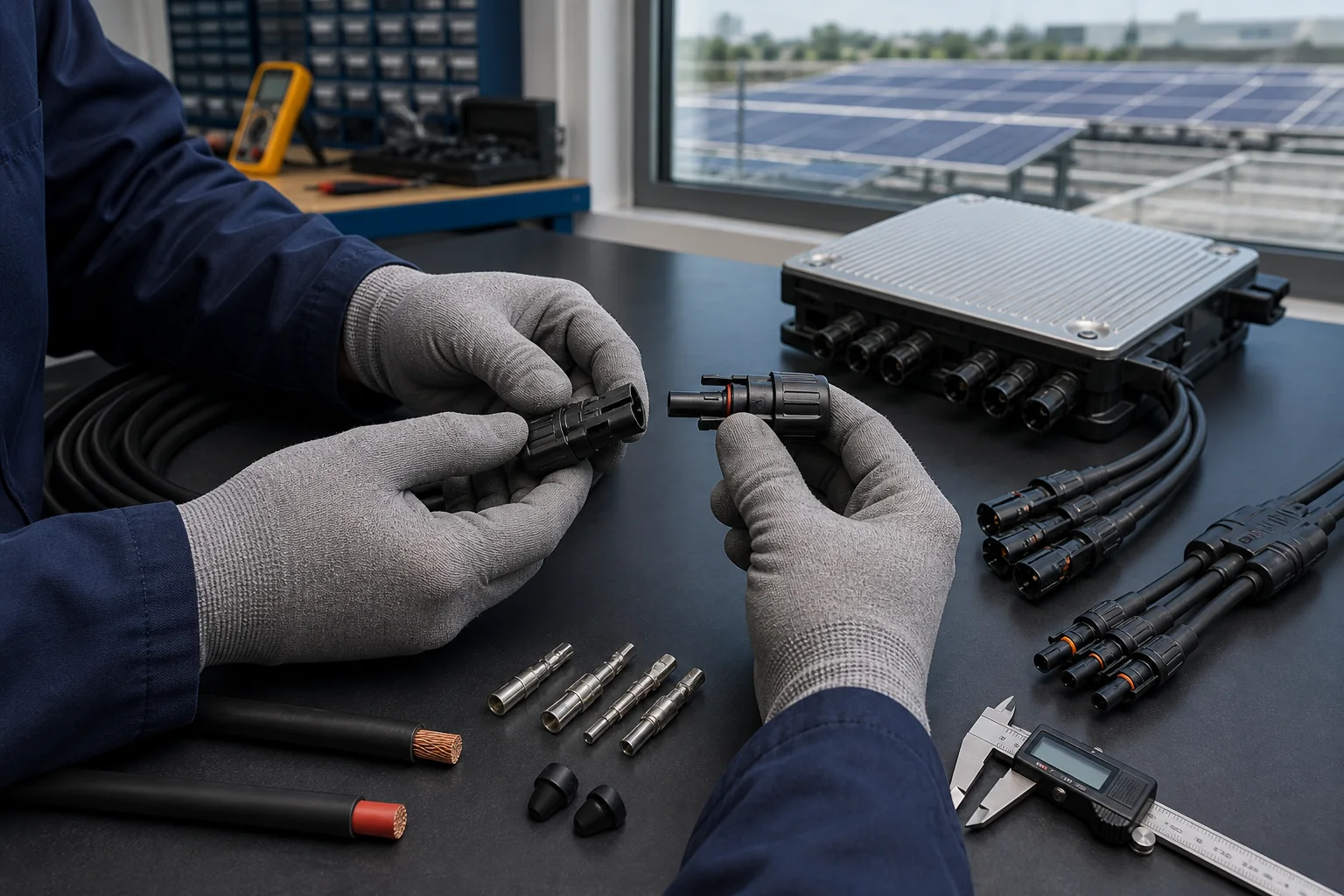
Microinverter RMA Triage: A Root-Cause Evidence Checklist for Distributors
A field-to-factory workflow for separating telemetry gaps from real failures, preserving serial-level evidence and closing corrective actions across a microinverter fleet.

TMG Technical Team
Quality & Applications Engineering

A distributor receives six complaints about the same microinverter model: three units show no data, two stopped producing at noon and one trips after rain. Replacing all six before checking site evidence can hide a gateway outage, a grid event or a genuine product defect. The useful RMA question is not simply “does the unit work?” but which observation proves which failure mode, on which serial-number population?
This checklist helps distributors, EPC service teams and OEM buyers organize first-line triage and a factory investigation. It is not permission to open or test energized equipment. Follow the exact product manual and local electrical-safety rules; a qualified technician should isolate and verify the circuit before any physical inspection.
Separate a monitoring alarm from an electrical failure
An offline dashboard is a symptom, not a diagnosis. NREL's inverter downtime analysis explains why missing communications must be distinguished from actual inverter downtime when analyzing operational data. Its fleet research is not a microinverter failure-rate claim, but the diagnostic principle applies: compare independent evidence before classifying a unit as failed.
For each affected device, align the timestamps of the app alarm, gateway last contact, AC meter or circuit reading, device energy counter and neighboring units on the same branch. If all devices disappear from one gateway at once while the site meter still records generation, investigate connectivity first. If one device stops exporting while peers on the same circuit continue under similar irradiance, pursue device, module, connector and branch-specific causes. A grid outage or protection trip may explain simultaneous zero output without a hardware defect.
Do not “fix” the account, clear alarms or update firmware before exporting the original logs. The Wi-Fi monitoring handover checklist helps establish who owns the portal and can retrieve that evidence.
Capture a serial-level intake record
Use one case ID per affected unit, then link related cases to a fleet incident. The minimum useful intake is:
| Evidence | Record at first contact | Why it matters |
|---|---|---|
| Identity | Model, serial, hardware revision, firmware, production/batch label | Defines the potentially affected population |
| Installation | Site, commissioning date, module model and allocation, AC branch, grid profile | Separates configuration and site effects |
| Symptom | First/last occurrence, local time zone, exact alarm and screenshot | Allows log and meter correlation |
| Operating context | Weather, shading, ambient conditions, recent outage or service | Tests environmental triggers |
| Independent output | Meter reading, local indicator, energy counter, peer comparison | Tests whether “offline” means no generation |
| Physical condition | Photos of housing, connectors, mounting, cable route and labels | Preserves as-found condition |
| Change history | Gateway, account, firmware, grid setting and installer changes | Detects a common-cause event |
Store the original file, export time, source account and person collecting it. Avoid screenshots alone when raw CSV or log exports exist. Redact customer personal data before sharing, but retain a controlled site-to-case mapping for follow-up.
Use a safe first-line triage tree
- Safety gate: smoke, heat damage, exposed conductors, water ingress or repeated protective-device trips require isolation and escalation. Do not reconnect for a quick video.
- Data gate: verify gateway power, network state, account assignment and clock synchronization. Compare portal data with an independent meter or local reading.
- System gate: check whether the issue is site-wide, one AC branch, one module input or one serial number. Record grid-voltage/frequency events and protective-device operation where accessible to qualified staff.
- Configuration gate: compare approved grid profile and firmware with the commissioning record. Changes should use a controlled procedure, not an undocumented remote reset.
- Hardware gate: only after the above, document visual evidence and request supplier-authorized tests. Do not swap incompatible PV connectors or open a sealed device in the field.
The firmware change-control guide covers version baselines and rollback evidence. If the suspected fault concerns a new OEM configuration, compare it against the approved sample test plan.
Define the return threshold before shipping
A return authorization should identify the hypothesis and tests still needed. Attach the case ID, serial-label photo, alarm export, relevant time series, installation diagram, site measurements taken safely, troubleshooting already performed and the authorized firmware/configuration state. Note any physical damage or prior intervention. Preserve the unit as received; use appropriate protective packaging and a custody log showing who disconnected, stored and shipped it.
Agree with the supplier which cases qualify for advance replacement, return-first inspection or remote resolution. “No fault found” is a test result under stated conditions, not proof that the customer had no incident. A factory report should list test setup, input and grid conditions, software version, duration, measured result and whether the field symptom could be reproduced. If not, specify the remaining evidence gap and next test.
Close the loop from factory finding to fleet action
The supplier's final report should distinguish observed damage, confirmed root cause and plausible but unproven hypotheses. Link the finding to the affected serial/BOM/firmware range; test whether the issue spans one batch, one installer practice or one site environment. For each corrective action, name the owner, implementation date, verification test and effectiveness check on subsequent production and field cases.
Do not publish “failure rate” from a handful of returns without the installed-unit denominator, observation period, deployment mix and consistent case definition. NREL's maintenance-record study shows the value of structured fault records, but a later NREL data review notes its dataset is heavily weighted toward utility-scale and central inverters. Those figures must not be presented as microinverter reliability benchmarks. The IEA PVPS O&M guidelines likewise support consistent monitoring, inspection and performance indicators across climate conditions.
Track at least time to acknowledge, time to classification, confirmed-defect share, no-fault-found share, repeat incidents after replacement, replacement lead time and closure of corrective actions. Segment by model, batch, firmware, climate and installer only where the sample is large enough to be meaningful.
Put the evidence contract into the RFQ
Before placing a volume order, request the supplier's intake form, diagnostic log fields, retention period, secure export method, return packing instructions, test-report template, batch-traceability method, escalation owners and corrective-action response times. Ask who pays for site diagnosis, freight and labor, and when advance stock is released. The warranty due-diligence guide covers those commercial terms; this checklist defines the evidence needed to apply them.
For a private-label program, make sure serial labels, firmware identifiers, gateway accounts and service records remain traceable after brand customization. The OEM distributor solution is the relevant starting point. Send the target market, selected model, service territory, expected installed base and proposed RMA workflow through TMG Contact to discuss an exact-configuration evidence and support plan. Do not infer a specific fault rate or response SLA from this general guide.
Sources & further reading
- https://docs.nrel.gov/docs/fy20osti/76022.pdf
- https://www.nrel.gov/docs/fy21osti/78736.pdf
- https://www.nrel.gov/docs/fy24osti/90315.pdf
- https://iea-pvps.org/key-topics/guidelines-for-operation-and-maintenance-of-photovoltaic-power-plants-in-different-climates/
Last reviewed September 29, 2026.