How to Review Microinverter DC/AC Ratio and Clipping for High-Power Modules
A B2B sizing method that separates acceptable annual energy clipping from unsafe voltage, current or input-power mismatches.

TMG Technical Team
Applications Engineering
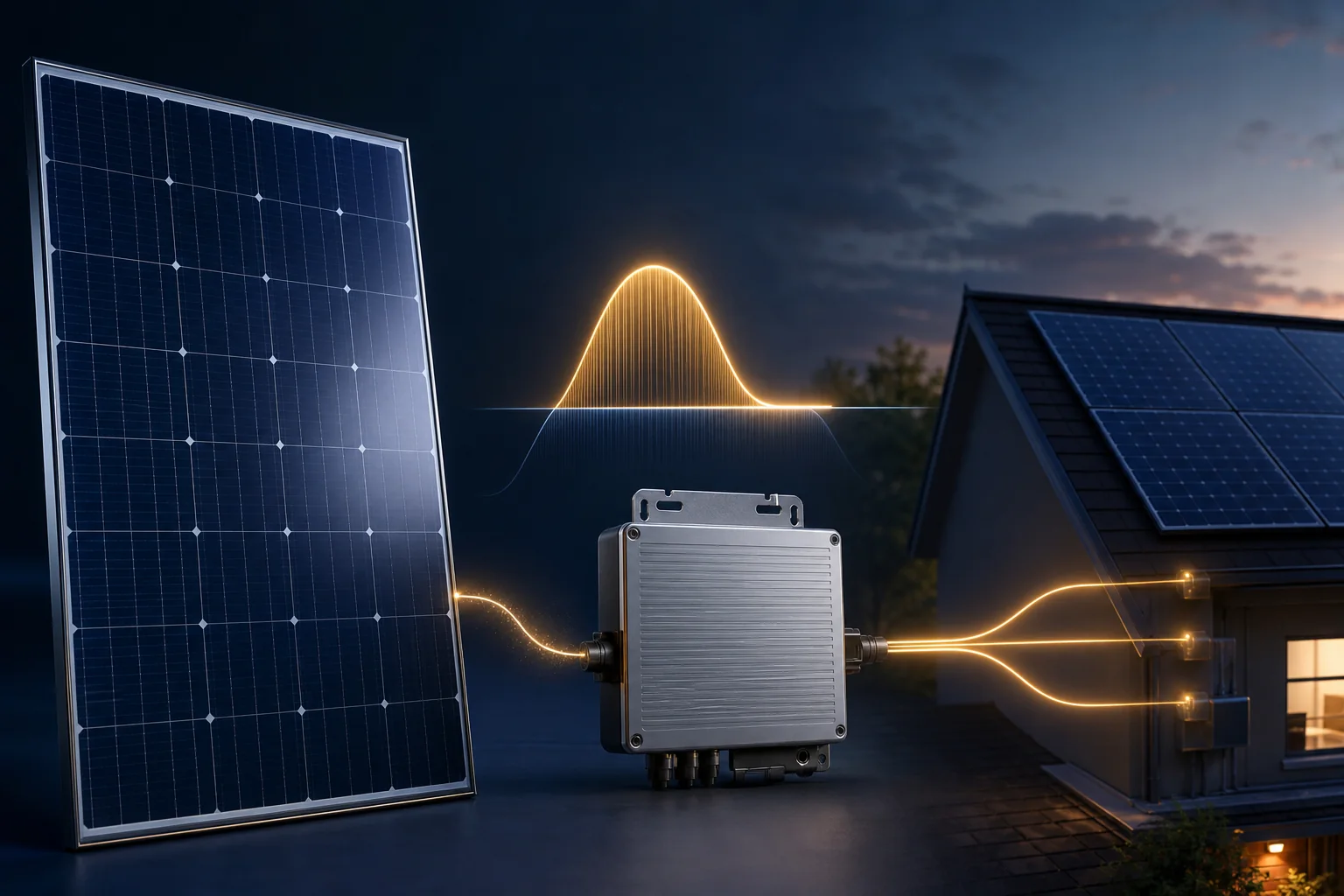
Pairing a 600 W module with a lower-rated microinverter is not automatically wrong, and it is not automatically acceptable. The DC/AC ratio is an energy-design choice; input voltage, current and power limits remain equipment constraints.
Calculate the ratio correctly
For one input or one inverter allocation, use:
DC/AC ratio = connected module nameplate DC power ÷ inverter rated AC output power
A 600 W module assigned to a 500 W AC output gives a nameplate ratio of 1.20. That number does not predict annual clipping by itself. Irradiance, module temperature, orientation, soiling, shading, bifacial gain, inverter efficiency and the output-control profile all affect the actual power trace.
Separate three decisions
1. Electrical compatibility
Confirm cold-corrected Voc, hot-condition Vmp, Imp and Isc against the exact input limits. Start with the high-current module matching guide. A favorable annual energy model cannot override an input limit.
2. Manufacturer-permitted DC loading
Check the allowed module input power and configuration in the model documentation. “Recommended module power” and “absolute electrical limit” are not interchangeable terms. Ask the supplier to state the permitted combination in writing.
3. Project energy economics
Model the expected hourly or sub-hourly performance using a defensible weather file and loss assumptions. NREL's PVWatts is useful for preliminary energy estimates, while the System Advisor Model supports more detailed technical and financial modeling. Record the software version, inputs and loss settings so the result can be reproduced.
Why some oversizing can be rational
PV modules reach nameplate power only under specific test conditions. Real operating power is often lower because cells run hotter, irradiance changes and system losses occur. A moderate DC/AC ratio can keep the inverter operating nearer useful output for more hours, but it may clip peak production around strong irradiance periods.
The right question is not “Does clipping occur?” It is “How much annual energy is clipped, what is gained during lower-output hours and does the selected equipment permit the design?”
Use scenario analysis, not one forecast
| Scenario | Change to test | Procurement implication |
|---|---|---|
| Base | Expected weather, orientation and losses | Reference yield |
| High irradiance | Stronger resource or bifacial contribution | Upper clipping case |
| Hot module | Higher operating temperature | Lower voltage and power |
| Partial shade | Site-specific obstruction profile | Module-level energy effect |
| Output limit | Utility or anti-export cap | Curtailment separate from clipping |
Report clipping loss separately from shading, availability and export curtailment. Combining them into one unexplained “system loss” prevents useful comparison between suppliers.
Questions for a distributor quotation
- What exact module and wattage bin is proposed?
- How many modules feed each input and inverter?
- Is the stated AC output continuous at the project's ambient condition?
- What input power, current and voltage limits apply?
- Which energy assumptions were used to recommend the ratio?
- Is warranty coverage affected by the proposed pairing?
- Are utility output limits included in the model?
TMG's APLV and APHV pages publish model-level input and output values for initial screening. Send the module datasheet, layout, location and desired AC capacity through TMG Contact for a configuration review before treating a DC/AC ratio as approved.
Sources & further reading
Last reviewed February 6, 2025.