Coastal Salt-Mist Qualification for Microinverters: A Buyer Checklist
How EPCs and importers can review corrosion exposure, materials, cyclic salt-mist evidence and maintenance limits for coastal microinverter projects.

TMG Technical Team
Product Reliability
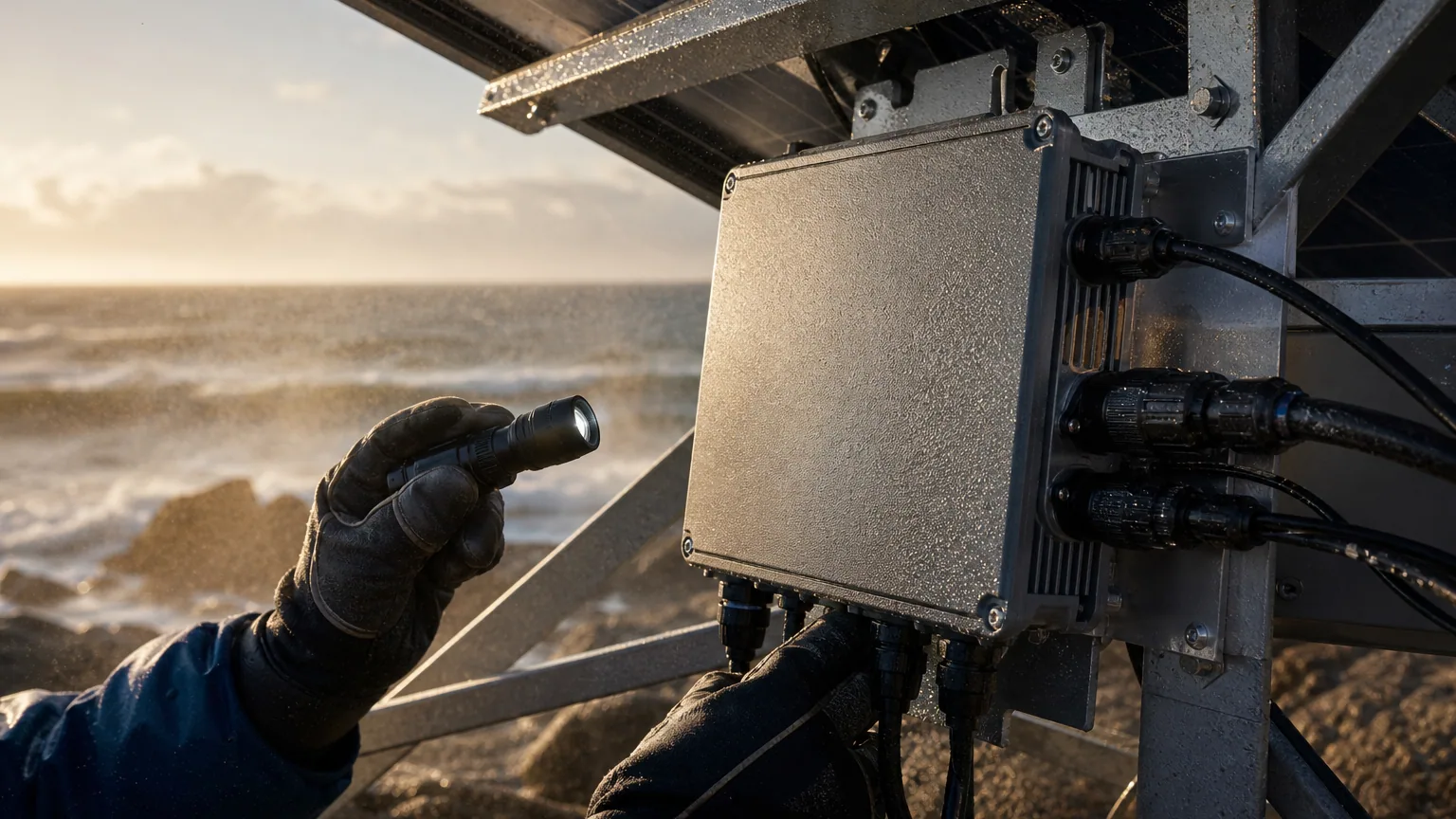
An IP rating does not prove corrosion resistance. A sealed enclosure can still suffer connector attack, fastener rust, galvanic corrosion or salt deposits that create leakage paths. Coastal procurement therefore needs a corrosion dossier separate from the ingress-protection certificate.
Define the exposure before requesting a test
“Near the sea” is not an engineering condition. Record distance from surf, prevailing wind, direct spray, humidity, industrial pollutants, mounting orientation, shelter, cleaning access and expected service life. Salt concentration can change sharply across the same site.
Classify whether the inverter is under a module, beneath a balcony, inside a ventilated cabinet or directly exposed. A laboratory cycle must be interpreted against this use case; it does not reproduce every coastal microclimate.
Request evidence for the inverter, not the module
IEC 60068-2-52 describes cyclic salt-mist testing for components and equipment. IEC 61701 is specifically a salt-mist test for photovoltaic modules. A module certificate carrying IEC 61701 is not evidence that the microinverter, connectors or AC branch accessories were tested.
The supplier dossier should identify the exact inverter model, test severity or cycle, preconditioning, powered or unpowered state, mounting position, acceptance criteria and post-test functional checks.
| Area | Evidence to request | Typical failure to inspect |
|---|---|---|
| Enclosure | Alloy/coating specification and test photos | Pitting, coating lift |
| Fasteners | Material and mating-metal details | Red rust, seized threads |
| DC/AC connectors | Material system and sealing arrangement | Green corrosion, tracking |
| Cable entries | Gasket and strain-relief construction | Salt path into enclosure |
| Earthing point | Contact stack and torque instruction | Increased resistance |
| Labels | Material and adhesion evidence | Lost safety identification |
Review galvanic pairs and installation damage
Dissimilar metals in an electrolyte can create a corrosion cell. Ask how aluminum housings, stainless fasteners, plated copper contacts and mounting rails are isolated or made compatible. Field drilling, scratched coatings and unapproved hardware can defeat the evaluated design.
The installation manual should state permitted mounting hardware, torque, drainage orientation and whether protective coatings may be repaired. Do not add grease or sealant to electrical connectors unless the connector manufacturer approves it.
Inspect function after exposure
A cosmetic pass is insufficient. The qualification plan should include insulation and protective-earth checks, connector operation, communication, power conversion, seal inspection and evidence that markings remain legible. Acceptance limits should be written before testing.
Ingress protection is still relevant, but it answers a different question. Use the IP67 procurement guide to verify seals and installation conditions alongside the corrosion review.
Build coastal controls into the purchase order
Freeze enclosure alloy, coating process, fastener grades, connector families and mounting accessories as controlled BOM items. Require supplier notification before any material or process change. Add receiving inspection for coating damage, mixed fasteners and connector contamination.
The project maintenance plan should define safe visual inspections and cleaning only where the manufacturer permits it. Warranty wording should also disclose exclusions for direct immersion, chemical pollution or unapproved mounting; the warranty due-diligence guide shows how to compare those terms.
Send site photos, distance from the coast, mounting details and required lifetime through TMG Contact. The result should be a model-specific qualification plan, not a generic “anti-corrosion” claim.
Sources & further reading
Last reviewed February 26, 2024.