OEM Microinverter Export Packaging: Drop, Vibration and Carton Qualification
A B2B test and documentation plan for preventing connector, enclosure and accessory damage during parcel, pallet and mixed-mode export distribution.

TMG Technical Team
Quality & Supply Chain
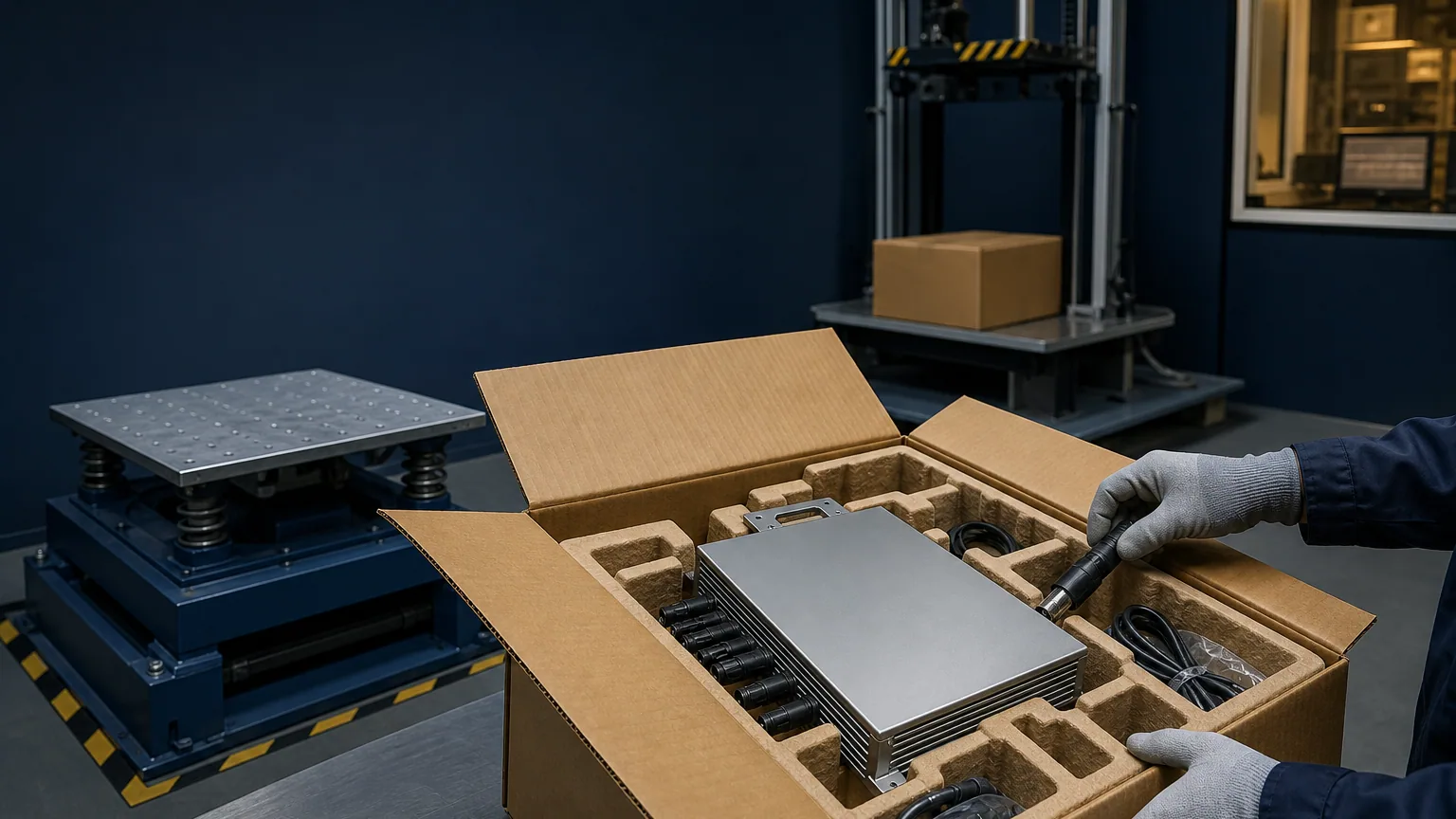
A microinverter can pass electrical inspection and arrive with bent connectors, abraded cables or cracked accessories because packaging was never qualified as a complete system. Export packaging must be designed around the product, pack quantity and actual distribution route.
Define the distribution channel first
Record unit and carton mass, dimensions, pallet pattern, parcel versus freight handling, stacking time, climate, number of trans-shipments and whether cartons may ship individually. ISTA 3A applies to packaged products up to 70 kg moving through parcel delivery; another procedure may be more appropriate for palletized or other distribution systems.
Do not choose a test solely because a supplier used it on a previous product. ISTA's procedure selection begins with how the packaged product is distributed.
Freeze the complete pack configuration
The test sample should contain the production inverter, AC/DC leads, connectors, gateway, manuals, mounting hardware and every loose accessory. Document bag materials, separators, cushioning density, carton grade, tape pattern, moisture protection and pallet wrap.
| Packaging risk | Design control | Inspection evidence |
|---|---|---|
| Connector impact | Recess or rigid separation | Post-test mating check |
| Cable abrasion | Retention and edge clearance | Jacket visual inspection |
| Enclosure-to-enclosure contact | Divider or individual tray | Surface and seal check |
| Loose hardware | Sealed, labeled compartment | Count and containment |
| Moisture exposure | Suitable bag/desiccant strategy | Packaging specification |
| Carton collapse | Board and stacking design | Compression result |
Use an ordered test sequence
Distribution tests commonly combine atmospheric conditioning, compression, vibration and shock/drop elements. The sequence matters because earlier stresses can weaken the package before later events. Use the official current procedure and an experienced test laboratory; this article does not reproduce proprietary test parameters.
Define acceptance before the test. “No visible carton damage” is too narrow. Inspect enclosure deformation, connector alignment, cable insulation, fasteners, seals, label readability, protective-earth continuity, insulation behavior, power conversion and monitoring.
Test worst-case and production-representative samples
Identify the heaviest and most fragile configurations. If one carton can contain different model combinations, justify which arrangement is worst case. Samples should use production-equivalent materials and packing work instructions.
Retain pre- and post-test photos, serial numbers, laboratory report, deviations and functional results. Link packaging revision to the product BOM. The OEM sample test plan can supply the electrical checks before and after distribution testing.
Requalify after meaningful changes
ISTA guidance recommends retesting when the product, package or process changes. Triggers can include a heavier model, new connector orientation, thinner carton, different cushion supplier, changed pack count or new parcel channel.
Add a controlled packaging approval sample at the packing station. Receiving teams should compare carton marking, protection and accessory count against that standard.
Convert damage data into corrective action
Track damage by shipment, lane, carton revision and failure location. A dented outer box with a protected product may be acceptable under the agreed criteria; an intact carton with connector micro-cracking is not. Investigate evidence instead of merely adding more foam.
Send the pack list, weights, carton drawing, shipment route and damage history through TMG Contact. A packaging specification should be released with the same discipline as the electrical BOM.
Sources & further reading
- https://www.ista.org/test_procedures.php
- https://www.ista.org/getting_started_with_design.php
- https://mms.ista.org/members/store_product.php?orgcode=ISTA&pid=20939871
Last reviewed November 18, 2024.